
Jewelry Repair and Custom Work
When a piece of jewelry breaks, or when you visualize a custom design that cannot be found in a corporate store, where your jewelry goes matters. While corporate mall stores and even many local brick-and-mortar shops ship your precious heirlooms out to third-party mass production hubs, Jewelry by Christopher does things completely differently.
At their full-service, in-store workshops in Loves Park, Illinois and Beloit, Wisconsin, your repairs and custom fabrications are managed by an expert team utilizing over 30 years of expert bench experience to oversee the entire fabrication and repair lifecycle right before your eyes.
Here is an inside look at how master-level repairs and bespoke custom designs are executed in-store.
The Danger of Subpar Training vs. Certified Mastery
The reality of the jewelry industry is that a staggering number of today’s bench jewelers lack formal, certified education. This isn’t just a corporate problem—many independent, local brick-and-mortar jewelry stores employ jewelers who lack sufficient skills and rely on outdated or improper techniques.
Don’t be fooled by a fancy local jewelry store. The overhead for these extravagant retail spaces is extremely expensive. Because so much capital is poured into maintaining a luxurious storefront, these businesses most likely cannot afford to employ the level of expertise of a true master jeweler at the bench.
- The Trap of the “Self-Proclaimed” Master Jeweler: Many retail jewelers will boldly label themselves a “master jeweler” on their website or store window, but completely lack any formal certifications or legitimate qualifications. These are self-proclaimed titles used purely as marketing gimmicks. Entrusting your precious family heirlooms to a self-titled jeweler is incredibly dangerous; without verified credentials, you have zero guarantee that they understand the physical limits of precious metals, often resulting in permanent damage to your jewelry.
- The Cycle of Inferior Training: Many jewelers are taught by mentors who themselves possess non-sufficient skills. This means bad shortcuts, improper techniques, and a flawed understanding of metallurgy are passed down through the trade from one generation of inferior jewelers to the next, continuing a cycle of subpar work across both corporate chains and local brick-and-mortars.
- Why Uncertified Repairs Easily Break: Without formal schooling, jewelers trained under uncertified peers lack a fundamental understanding of metallurgic physics. They might apply too much heat with a torch, choose the incorrect solder density, or improperly balance the stress points of a ring shank. This structural guesswork is precisely why repairs frequently break again just weeks after you pick them up.
The Prestigious Reality of True JA Certification
To cut through the noise of self-proclaimed marketers, Jewelers of America (JA) established the nation’s only objective, multi-tiered benchmarking system. Christopher Cole stands entirely apart from the crowd as the only Jewelers of America (JA) Certified Master Jeweler in Northern Illinois and Southern Wisconsin.
The Extreme Rigor of JA Master Testing
The title of Certified Master Bench Jeweler (CMBJ) is the highest and most prestigious rank a jeweler can earn in the United States. It is a distinction held by a fraction of one percent of all working jewelers. It cannot be bought or handed down; it must be earned through brutal, strictly timed testing:
- Exhaustive Technical Examinations: Candidates must execute a wide array of highly complex fabrication, casting, and advanced stone-setting tasks right under the scrutiny of industry judges.
- Zero Room for Error: The completed test pieces are sent directly to a national grading facility. There, judges evaluate the work under intense magnification, checking for flawless geometric precision, microscopic structural integrity, and perfect metal tolerances. A single microscopic flaw or loose prong results in immediate failure.
- The In-and-Out Mastery: True mastery requires a complete structural education on how jewelry is built from the ground up. Because Christopher Cole has successfully proven his grasp of the exact physics, construction, and inner workings of how a piece is truly made, he knows exactly how to tear it down and repair it properly. When you know the ins and outs of custom fabrication at a certified master level, executing a seamless, permanent repair becomes second nature.
1. The Repair Process: Restoring What is Broken
Corporate jewelry care typically involves a retail associate filling out a shipping slip and placing your ring in a mail bin.
- The Microscopic Diagnostic: Every repair begins with an in-store evaluation. Utilizing specialized magnification, the bench jewelers inspect your piece for hidden structural weakness, such as hairline fractures in metal shanks or worn-down prongs that could drop a gemstone.
- Laser Welding and Torch Control: For delicate repairs near heat-sensitive stones (like opals or emeralds), the workshop uses highly accurate laser welding equipment. For structural rebuilds, master torch control is used to seamlessly apply gold or platinum, ensuring a repaired area is just as strong as the day it was first cast.
2. “Custom is What We Do”: Transforming Old into New
The signature of the brand is its specialized approach to custom creation, particularly recreating beautiful new jewelry using a client’s old, sentimental gold and gemstones. Instead of trading your family heirlooms for pennies on the dollar, the master workshop transforms them into wearable works of art.
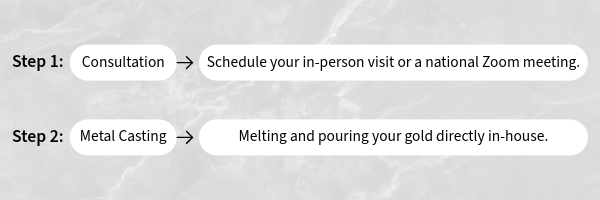
Step 1: The Design Consultation
To ensure you receive undivided attention and personalized service, a design appointment is required. Local clients can easily call ahead to schedule an in-person consultation at either showroom. For Christopher Cole’s national clients, the team hosts virtual Zoom meetings upon request to map out your vision, stone placements, and structural considerations from anywhere in the country. To support this national reach, the workshop safely and securely ships finished custom jewelry nationwide.
Step 2: In-House Precious Metal Casting
This is where true master craftsmanship sets the store apart from competitors. Once your design concepts are finalized, the team takes your old jewelry—or fresh precious metals—and melts it down directly inside the workshop. The molten gold or platinum is poured into an in-house casting furnace, converting your raw materials or heirlooms into a dense, solid, customized foundation.
Stay Connected With Us Online!
Are you ready to see what is possible with your collection? You can explore the Jewelry by Christopher Custom Gallery to see past designs, or reach out today to schedule your local or national consultation.
To stay inspired by daily artisan mastery, visit Jewelry by Christopher on Facebook to see Christopher’s latest custom creations. You can also follow Christopher Cole Jewelry by Christopher on Instagram to browse our gallery of stunning, freshly cast heirloom masterpieces.