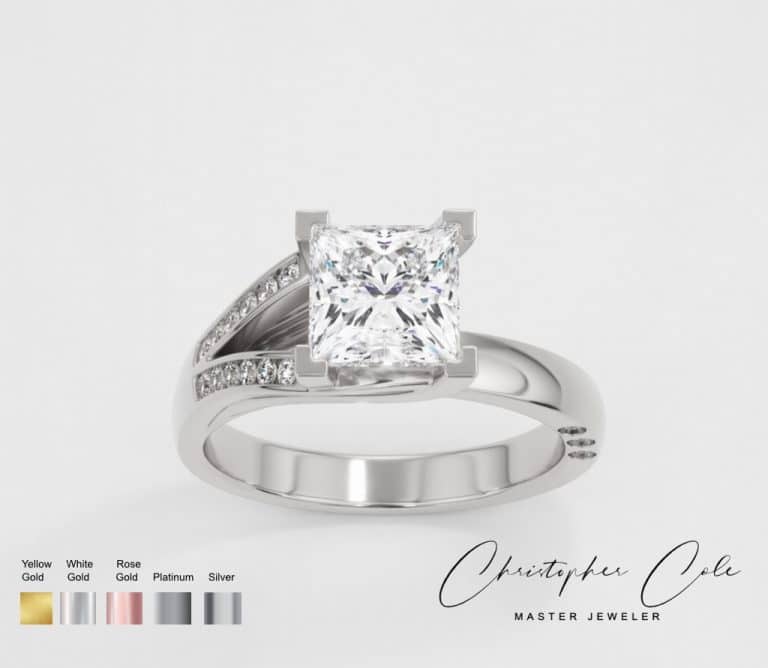
Where Is Your Jewelry Being Made From Some Major Corporations?
The vast majority of the jewelry sold by major retail corporations is manufactured thousands of miles away in overseas mega-factories. From mall jewelers to high-end fashion brands, outsourcing production to international hubs has become the corporate standard. While this global supply chain maximizes corporate profit margins and ensures high-volume output, it comes at a steep cost to quality, transparency, and the preservation of traditional jewelry skills.
Understanding how overseas manufacturing operates reveals exactly why having your jewelry built by an independent craftsman living right here in America is a vastly superior choice.
Inside the Corporate Overseas Supply Chain
To understand why major corporations outsource, you have to look at how global jewelry hubs operate:
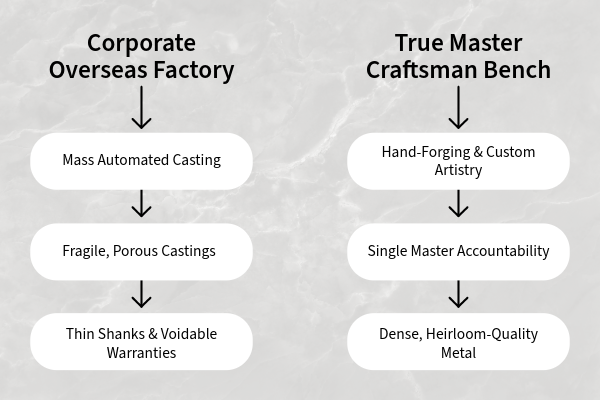
- Mass-Volume Stamping and Casting: In manufacturing hubs across East Asia, jewelry is rarely touched by a master artisan. Instead, automated liquid-injection molds and high-speed stamping machines churn out thousands of identical ring shanks and settings every hour.
The Corporate Illusion: Hollow Quality and Trapped Warranties
Because mass production prioritizes cutting costs over structural integrity, corporate jewelry lines are intentionally engineered to save on precious metal weight.
- The Thinness and Lack of Metal: To maximize profits, corporate jewelers shave away metal wherever possible. This results in rings with dangerously thin shanks, hollowed-out under-galleries, and razor-thin prongs. While the piece looks substantial from the top, it lacks the structural mass to withstand everyday wear, leading to bent bands and warped settings.
- Why They Sell You an Extended Warranty: When you buy a mass-produced piece, the sales associate will almost always pressure you into buying an extended service plan or warranty. Corporations do this because they know the jewelry lacks true craftsmanship and will break. The warranty isn’t a perk; it is a built-in insurance policy for an inferior product.
- The “Easily Voidable” Trap: These corporate warranties are packed with fine print designed to protect the company, not your jewelry. If you miss a mandatory six-month inspection by even a single day, the entire warranty is voided. Furthermore, if you take the piece to a local, skilled master jeweler for a quick emergency repair or sizing, the corporation will permanently cancel your coverage. It is a system designed to trap you into their ecosystem because the piece cannot stand on its own structural merit.
Why a True Master Craftsman Matters
When you step away from the corporate assembly line and work directly with a true master craftsman, you change how your jewelry is conceived, built, and preserved. Mastery cannot be automated, duplicated by a machine, or rushed down a conveyor belt.
1. Absolute Accountability and Pride of Work
A master craftsman owns the entire lifecycle of a piece from start to finish. They hand-carve the intricate wax models, control the physical metallurgy during the melt, and execute precise stone-setting under micrometric pressure. Because their personal name and reputation are forged into every creation, they refuse to cut corners. There is no passing a flawed casting down an assembly line; if it isn’t perfect, they melt it down and start over.
2. Heirloom Structural Integrity
Master goldsmiths understand the physical properties of metal at a structural level. By manually hand-forging, rolling, and drawing gold or platinum, they compress the molecular structure. This eliminates the microscopic air bubbles (porosity) that naturally occur in cheap, high-speed automated castings. The result is a much denser, heavier, and resilient piece of jewelry that can be worn for generations without bending out of shape.
3. Engineering Beyond Aesthetics
A factory machine only builds for visual appearance on a velvet display tray. A master craftsman designs for the realities of everyday human life. They engineer prongs with proper thickness to withstand decades of friction, build shanks with enough physical mass to be resized over a lifetime, and ensure the balance of the ring sits perfectly on your finger without spinning.
4. Preservation of a Living Art Form
Working with a true master craftsman keeps a dying, centuries-old human trade alive. As tech-driven corporate shortcuts dominate the market, true goldsmithing knowledge is disappearing. Supporting a master jeweler ensures that advanced torch control, hand-engraving, and heirloom restoration remain active, living skills passed down to future generations of artisans.